
Articles
The Most Dangerous Temperature Excursion Is the One That Happens at 2 AM
4 Minutes Read · Published 15 Oct 2026 · By Marius Jacobsen
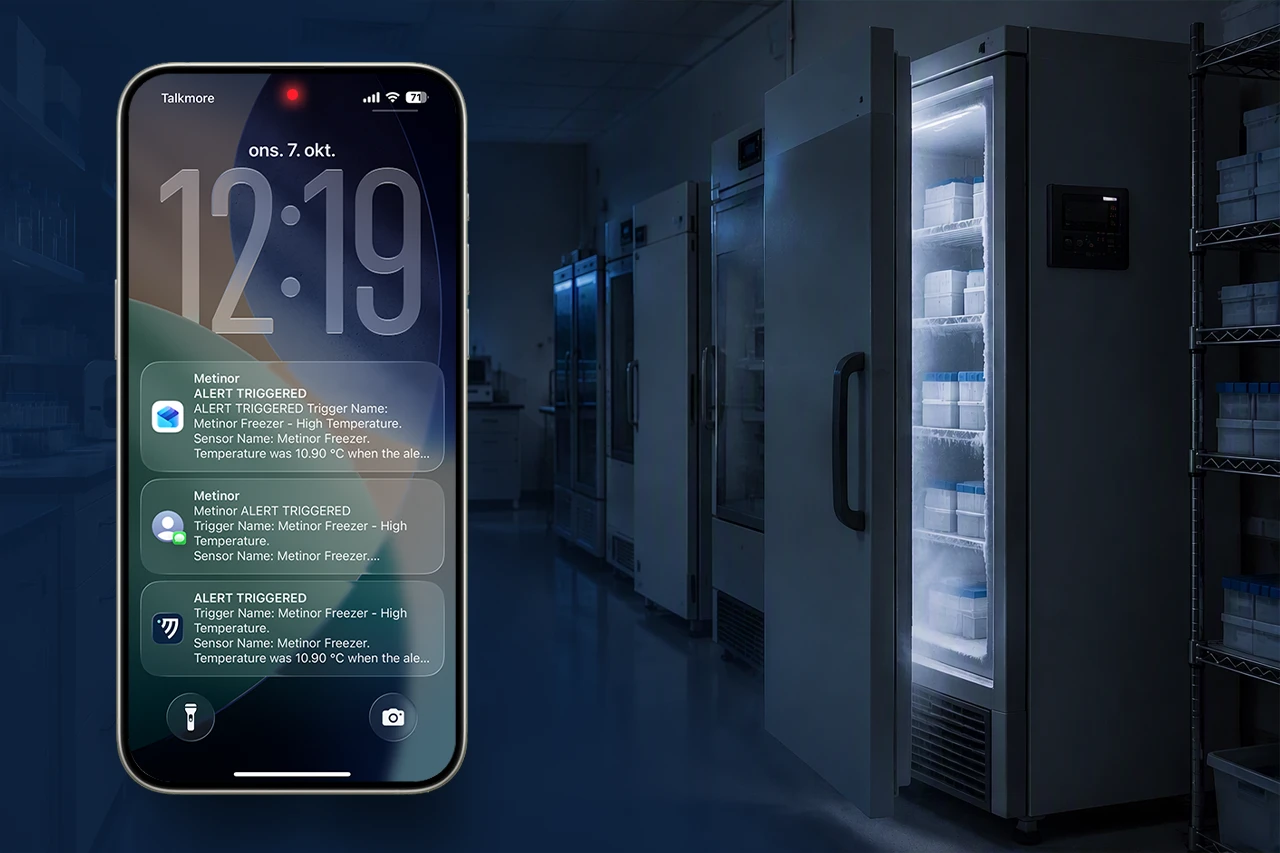
Not all temperature excursions are equally risky. A refrigerator exceeding its temperature limit at 10:00 AM is usually manageable because staff are on site, laboratories are operating normally, and notifications are likely to be seen quickly. Someone notices the issue, investigates the cause and takes action.
Now imagine the same excursion beginning at 2:00 AM on a Saturday. The refrigerator is in the same room, the temperature rises at the same rate, and the equipment behaves exactly the same way. The only difference is that nobody is there.
That difference can change everything.
Temperature Excursions Rarely Happen at Convenient Times
Environmental control systems do not care about business hours.
Refrigeration systems do not wait until Monday morning to fail; power interruptions do not check calendars. Equipment operates continuously, and risk operates continuously as well. Yet many laboratories still rely on processes that assume somebody will eventually discover a problem.
The question is how long that discovery takes. Because in environmental monitoring, the duration of an event is often just as important as the event itself.
The First Hour Matters
Consider two identical temperature excursions.
In the first scenario, personnel are notified immediately, the issue is identified, corrective action is taken, and the excursion lasts forty-five minutes.
In the second scenario, the excursion begins overnight and remains unnoticed until the following morning, resulting in an eight-hour event.
Both incidents started the same way and involved the same equipment, yet the outcome may be completely different. This illustrates why environmental monitoring is not simply about measuring conditions, but about reducing response time.
Small Problems Become Bigger Problems When Nobody Knows About Them
Many environmental events start as relatively minor issues.
- A refrigerator door is not fully closed.
- A cooling system begins operating inefficiently.
- A circuit breaker trips.
- A power interruption occurs.
If personnel are alerted quickly, these situations may be resolved before significant impact occurs. Without visibility, the same events can continue developing for hours. The difference between a minor deviation and a major investigation is often measured in time.
The Challenge of Nights, Weekends, and Holidays
Laboratories may not operate twenty-four hours a day, but environmental conditions do. This creates a reality that every quality manager understands: critical assets are often being stored during nights, weekends and holidays when staffing is minimal or nonexistent.
Samples remain in freezers, reagents remain in refrigerators, and products remain in controlled environments. Research continues to depend on conditions being maintained even when nobody is physically present.
The risk does not disappear simply because the building is empty.
Why Manual Checks Can Create False Confidence
Many organizations still perform routine environmental checks at the start of each day. The process seems logical: conditions are reviewed, readings are documented, and everything appears normal.
The challenge is understanding what happened between those checks.
A freezer that exceeds its temperature limit from midnight until 4:00 AM may have returned to normal by the time personnel arrive in the morning. The inspection shows an acceptable reading, but the excursion goes completely unnoticed.
This is one of the fundamental limitations of periodic monitoring. It provides information about specific moments in time, but not what occurred in between.
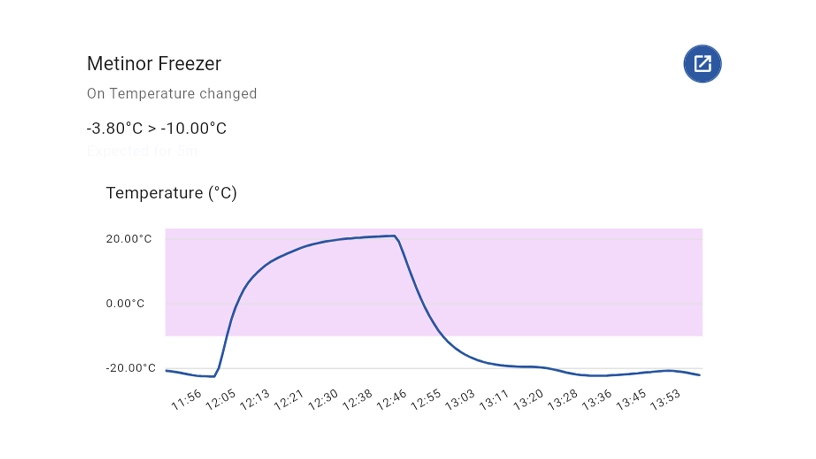
Freezer temperature excursion recorded by Metinor: a rise from −22 °C to +21 °C between 12:03 and 12:46, then recovery to −20 °C. The shaded area marks the alarm threshold (>−10 °C).
Investigations Become Difficult When Discovery Is Delayed
The longer it takes to discover an event, the more difficult it often becomes to investigate. Questions begin to emerge:
- When did the event start?
- How long did it last?
- What caused it?
- Were materials affected?
- Did anyone respond?
- Were alarm procedures followed?
Without detailed records, answering these questions can become surprisingly difficult. The investigation shifts from understanding facts to reconstructing possibilities. Such uncertainty rarely benefits anyone.
Speed Is Often More Important Than Perfection
Organizations sometimes focus heavily on preventing every possible excursion. While that goal is understandable, it is not always realistic: equipment can fail, doors can be left open, and power interruptions can occur. Unexpected events are part of operating any facility.
The more practical goal is often early detection. A rapidly detected event is typically easier to assess, easier to investigate, and easier to manage than one that continues unnoticed for hours.
In many cases, the difference between a minor issue and a significant quality event is simply how quickly someone becomes aware of it.
Environmental Monitoring Is Really About Awareness
People often think environmental monitoring is about sensors, alarms, or compliance. Those elements matter. But at its core, environmental monitoring serves a simpler purpose: awareness. Knowing what is happening, when it started, whether action is required, and knowing enough to make informed decisions.
Without that awareness, organizations are forced to react after the fact. With it, they have an opportunity to intervene while the situation is still developing.
The Excursion You Never See Is Usually the One That Creates the Biggest Problem
Most laboratories can manage a known excursion, as the event is documented, the impact is assessed, and appropriate actions are taken.
What creates difficulty is the event that occurs without anyone knowing. The freezer that drifted out of range overnight. The refrigerator that recovered before morning. The storage environment that spent hours outside specification while the building was empty.
These events create uncertainty, and uncertainty is rarely a comfortable position in a regulated environment.
Which is why the most dangerous temperature excursion is not necessarily the largest one, it is often the one that begins when nobody is watching.
Related reading


Ready to upgrade your monitoring solution?
Get in touch and our team will help you make the switch today.