
Articles
Alarm Fatigue in GMP Labs: When Too Many Alerts Become a Risk
5 Minutes Read · Published 29 Oct 2026 · By Marius Jacobsen
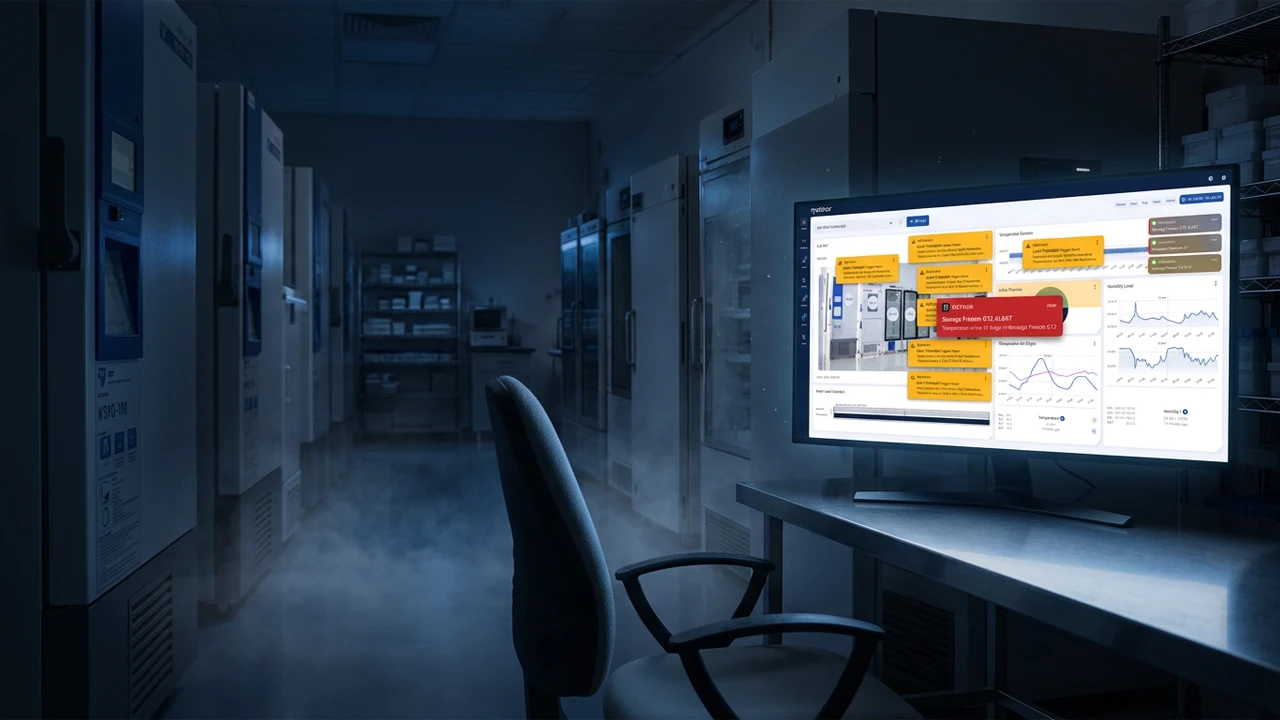
A temperature alarm is supposed to get your attention. But what happens when your team receives so many alerts that they stop paying attention?
In a GMP laboratory, environmental monitoring systems are designed to provide an early warning when conditions move outside defined limits. A temperature rises. Humidity changes. A freezer door is left open. A power failure affects critical equipment.
The alert comes through, someone responds, and the issue is addressed. At least, that’s how it is supposed to work.
But when laboratories generate large numbers of alarms, many of which are repeated, insignificant, or difficult to act on, another risk emerges: alarm fatigue. And alarm fatigue can turn an effective monitoring system into a source of noise.
What is alarm fatigue?
Alarm fatigue occurs when people are exposed to so many alerts that they become desensitized to them.
Instead of every alarm triggering an immediate response, employees may start:
- Ignoring notifications
- Dismissing alarms without investigating
- Delaying their response
- Assuming someone else will handle it
- Becoming less attentive to recurring alerts
- Missing a genuinely critical event among less important notifications
This isn’t necessarily because people are careless. It is often because the monitoring system is producing too much information without enough context or prioritization.
For laboratory teams already managing samples, equipment, documentation, deviations and other daily responsibilities, a constant stream of alerts can quickly become overwhelming.
A typical example
Imagine a laboratory where a refrigerator generates:
- 15 alerts each day due to routine door openings
- 8 alerts caused by short-lived temperature fluctuations
- 5 alerts generated during maintenance activities
After several weeks, staff begin to view notifications as routine background noise.
Then one Friday evening, a genuine equipment failure occurs. The critical alarm arrives, but it looks exactly like the other notifications received that week. That is when alarm fatigue becomes a risk. The issue isn’t that the laboratory lacked a monitoring system, it is that the people responsible for responding had become overwhelmed by alarms that rarely required action.
Not every alarm requires the same response
Not every alarm requires the same response.
Scenario 1: A refrigerator briefly reaches 8.1°C
The temperature limit is 8°C.
An alert is triggered.
The temperature returns to the acceptable range a few minutes later, with no impact on the stored material.
Scenario 2: A freezer temperature is steadily increasing
The freezer normally operates at -80°C.
The temperature has now reached -70°C and continues to rise.
An alert is triggered.
Both situations generate notifications, but they clearly don’t have the same urgency. If your system treats every event in exactly the same way, your team may end up receiving dozens of notifications that all look equally important.
Over time, that can make it harder to recognize the alarms that actually require immediate intervention.
Why alarm fatigue is particularly relevant in GMP environments
In a GMP environment, environmental monitoring isn’t simply about knowing what the temperature is. It is about being able to demonstrate that environmental conditions were controlled, that deviations were detected, and that appropriate actions were taken.
That means alarms are part of a larger process involving:
Detection → Notification → Investigation → Action → Documentation
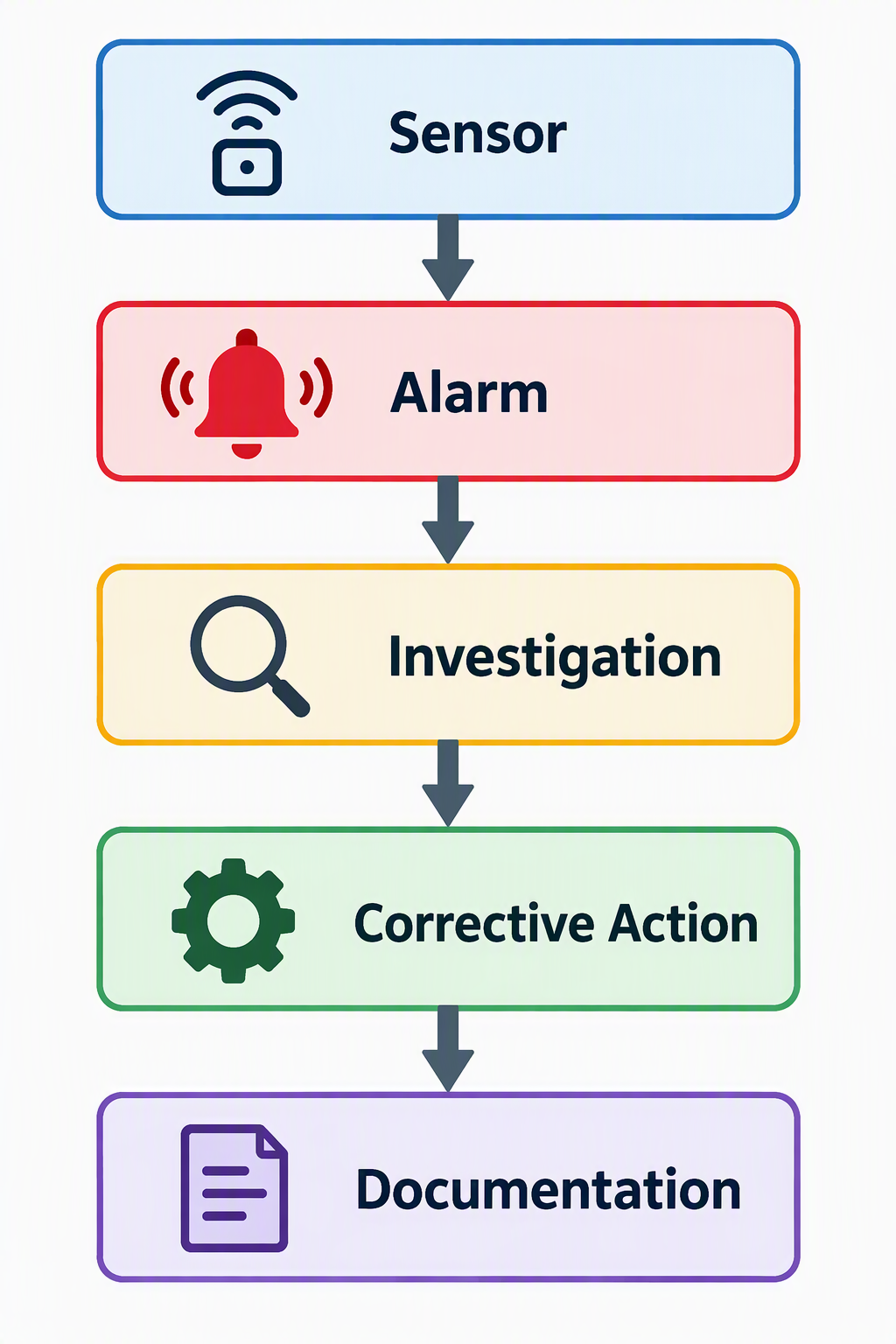
If the notification stage doesn’t work effectively, everything that follows can be affected. A delayed response to an environmental excursion could potentially mean:
- Greater exposure of temperature-sensitive materials
- Increased risk to samples or products
- Additional investigations
- Deviations and corrective actions
- More time spent reconstructing what happened
- Greater workload for laboratory personnel
The goal of an environmental monitoring system should therefore not simply be to generate alarms. It should be to generate useful, actionable alarms.
Where does alarm fatigue come from?
There are several common causes.
1. Too many unnecessary alerts
If a system generates an alert every time a measurement briefly crosses a threshold, teams can quickly become overwhelmed.
For example, a temporary temperature fluctuation caused by opening a refrigerator door may not require the same response as a sustained temperature excursion.
Without appropriate alarm settings, both can produce the same notification.
2. Alerts without context
Knowing that a temperature is outside its limit is useful. Knowing where, when, by how much, and for how long is much more useful.
An alert saying: “Temperature out of range” doesn’t tell the recipient much.
An actionable notification should provide enough information for the person receiving it to understand the situation and determine what needs to happen next.
3. Repeated notifications
A single event can sometimes generate multiple notifications across different channels.
Email. SMS. App notification. Dashboard alert.
For a critical event, redundancy can be valuable. But if every minor fluctuation creates a cascade of notifications, the result can quickly become notification overload.
4. Poorly defined alarm limits
Alarm limits should reflect the actual requirements of the monitored environment and equipment.
If limits are unnecessarily narrow, normal operational fluctuations may continuously trigger alarms.
If limits are too broad, genuine problems may not be detected early enough.
Finding the right balance is essential.
The goal isn’t fewer alarms. It’s better alarms.
Reducing the number of notifications isn’t necessarily the solution. After all, the purpose of environmental monitoring is to identify problems.
The better question is: Which events should require someone’s attention, and how quickly?
This is where thoughtful alarm configuration becomes important. A monitoring system should help distinguish between:
Informational events
Something changed, but no immediate action is required.
Warnings
Conditions are moving toward an unacceptable range and should be monitored.
Critical alarms
Conditions have reached a level where immediate investigation or action is required.
This kind of prioritization helps laboratory teams focus their attention where it matters most.
How can laboratories reduce alarm fatigue?
1. Review your alarm history
Start by looking at the alarms your system is actually generating.
2. Set meaningful thresholds
Alarm limits should be based on the requirements of the monitored equipment, materials and processes—not simply chosen to generate as many alerts as possible.
3. Consider duration, not just the measurement
A brief fluctuation may have a very different significance from a condition that remains outside the acceptable range for 30 minutes, one hour, or longer.
Where appropriate, alarm delays or persistence settings can help prevent insignificant short-term fluctuations from creating unnecessary alerts.
4. Prioritize critical events
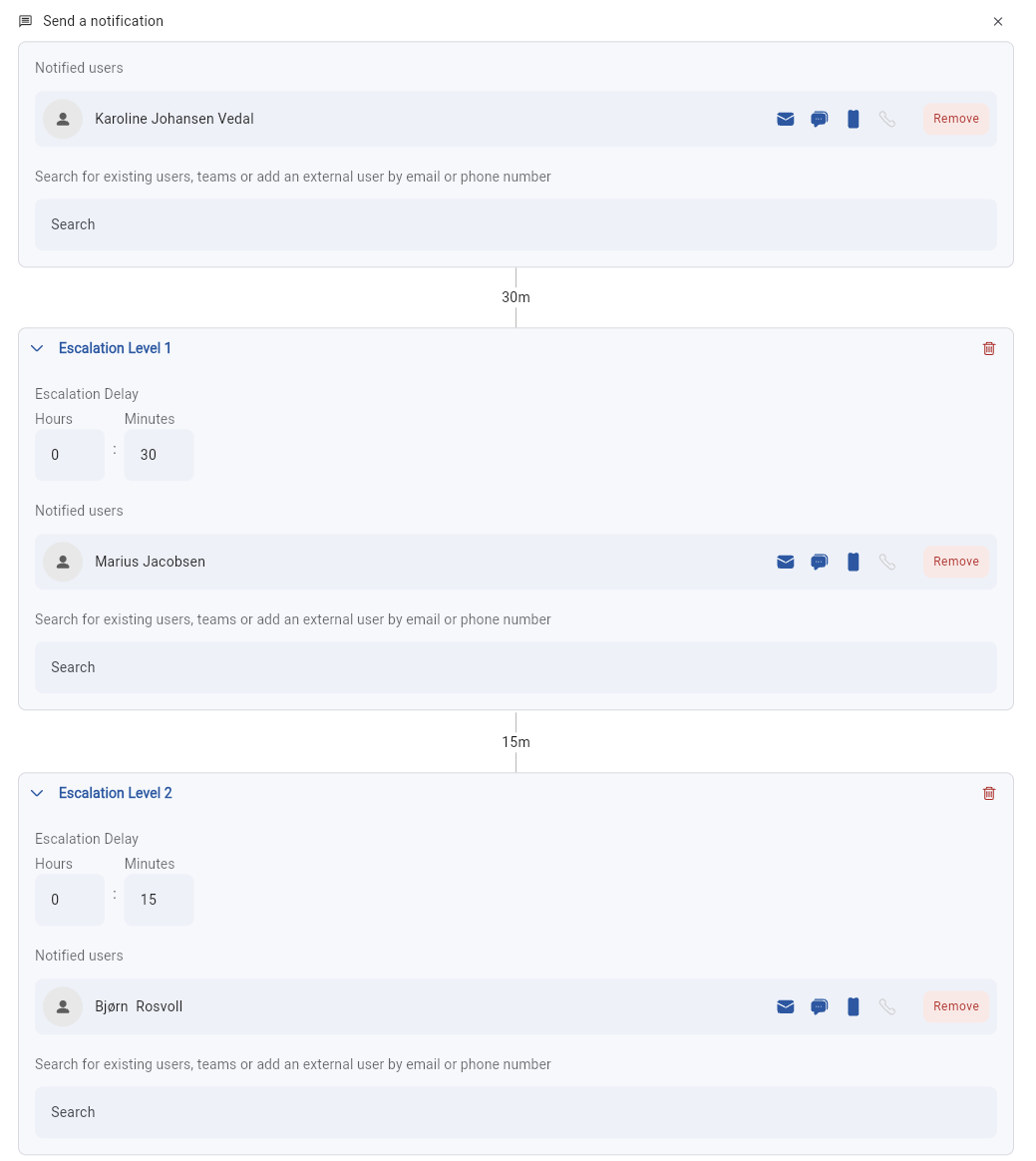
Not every notification needs to reach every person.
Critical alarms may require immediate escalation, while lower-priority events can be handled differently.
The objective is to make sure the right person receives the right information at the right time.
5. Make alerts actionable
An alert should help answer:
What happened? Where did it happen? How serious is it? What should I do next?
The easier it is to understand an event, the easier it is to respond appropriately.
Alarm details, acknowledgements, and user comments help provide context, document investigations, and create a clear audit trail for follow-up actions.
Continuous monitoring is only as effective as the response it enables
Continuous environmental monitoring gives laboratories something manual checks cannot: visibility between inspections. But monitoring itself isn’t the end goal.
The real value comes from being able to detect a change, understand its significance and respond before a small problem becomes a major one. That is why alarm management should be considered an important part of any environmental monitoring strategy.
A system that sends fewer, more relevant and more actionable alerts can help laboratory teams stay informed without becoming overwhelmed by notifications. Because when everything is an alarm, eventually nothing feels like an alarm.
A smarter approach to environmental monitoring
A modern environmental monitoring system should do more than collect measurements. It should help laboratories identify meaningful events, prioritize responses, and maintain a complete record of environmental conditions.
Environmental monitoring is only valuable is people respond to what it tells them.
The best monitoring systems don’t generate the most alarms.
They make sure the right alarms reaches the right person at the right time.


Ready to upgrade your monitoring solution?
Get in touch and our team will help you make the switch today.


