
Articles
How to Prove Sensor Accuracy During an Audit Without Taking Sensors Out of Service
4 Minutes Read · Published 01 Oct 2026 · By Marius Jacobsen
Few moments make laboratory personnel more uncomfortable than an auditor pointing at a temperature sensor and asking a simple question:
“How do you know that sensor is still accurate?”
On the surface, it sounds straightforward.
Most facilities have calibration certificates. Most can demonstrate that sensors were calibrated at some point in the past. Many have procedures describing how calibration is managed. Yet when auditors begin digging deeper, the discussion often becomes more complicated.
- How often is calibration performed?
- What happens between calibration intervals?
- How do you know the sensor did not drift?
- Can you prove the sensor remained within tolerance throughout its service life?
- Can verification be performed without removing the sensor from operation?
These questions matter because environmental monitoring data is only as trustworthy as the sensor generating it.
The Problem with Traditional Calibration Approaches
For decades, the standard approach has been relatively simple.
- A sensor is removed from service.
- It is shipped to a calibration laboratory.
- The sensor is calibrated.
- Documentation is generated.
- The sensor is returned and reinstalled.
The process works.
But it creates several practical challenges.
First, there is downtime.
A replacement sensor may need to be installed. Documentation may need updating. Personnel must manage the logistics of removal and reinstallation.
Second, there is cost.
Calibration itself is only part of the expense. Shipping, administration, scheduling, labor, and potential disruption all contribute to the total cost.
Third, there is a blind spot.
Calibration confirms sensor performance at a specific moment.
It does not necessarily provide evidence regarding what happened between calibration intervals. If a sensor develops an issue six months after calibration, the certificate does not automatically reveal it.
Why Auditors Care About More Than Certificates
Many organizations assume calibration certificates are the primary focus during audits.
Certificates are important, but they are rarely the entire story.
Auditors are often trying to answer a broader question:
“Can this organization demonstrate confidence in the integrity of its monitoring data?”
That question extends beyond calibration.
It includes:
- Traceability
- Documentation
- Verification procedures
- Drift management
- Change control
- Historical records
- Investigation processes
A calibration certificate may demonstrate that a sensor was accurate on a particular date.
A well-designed verification process helps demonstrate continued confidence in the sensor after that date.
Understanding Sensor Drift
Even high-quality sensors experience some degree of drift over time. The magnitude varies depending on sensor technology, operating conditions, environmental exposure, and application.
In many laboratory environments, drift occurs gradually. That creates a challenge. A sensor does not suddenly announce that it has moved outside specification. The readings continue to appear normal. Data continues to accumulate. The system continues to function.
Without a verification strategy, organizations may not discover an issue until the next scheduled calibration. This is why many quality professionals increasingly view verification as a complement to calibration rather than a replacement for it.
Verification vs Calibration
These terms are often used interchangeably, but they are not the same.
Calibration establishes the relationship between a sensor’s readings and a traceable reference standard. Verification confirms that a sensor remains performing within an acceptable tolerance. Think of calibration as setting the benchmark. Verification is checking whether the sensor continues to meet that benchmark.
- Both have value.
- Both support data integrity.
- Both contribute to audit readiness.
The strongest programs typically incorporate elements of each.
Why In-Service Verification Is Gaining Attention
One challenge with traditional approaches is that verification often requires removing equipment from operation. For facilities monitoring critical environments, that can create unnecessary complexity. Imagine a laboratory refrigerator containing valuable samples. Removing the monitoring sensor introduces additional work, additional documentation, and additional risk.
This has led many organizations to explore methods that allow sensor verification while the device remains installed and operational.
The advantages are significant:
- Reduced downtime
- Less disruption
- Faster execution
- Simplified documentation
- Greater operational continuity
Most importantly, verification can become practical enough to perform more frequently.
A Practical Approach to Sensor Verification
Modern environmental monitoring systems increasingly support on-site verification processes.
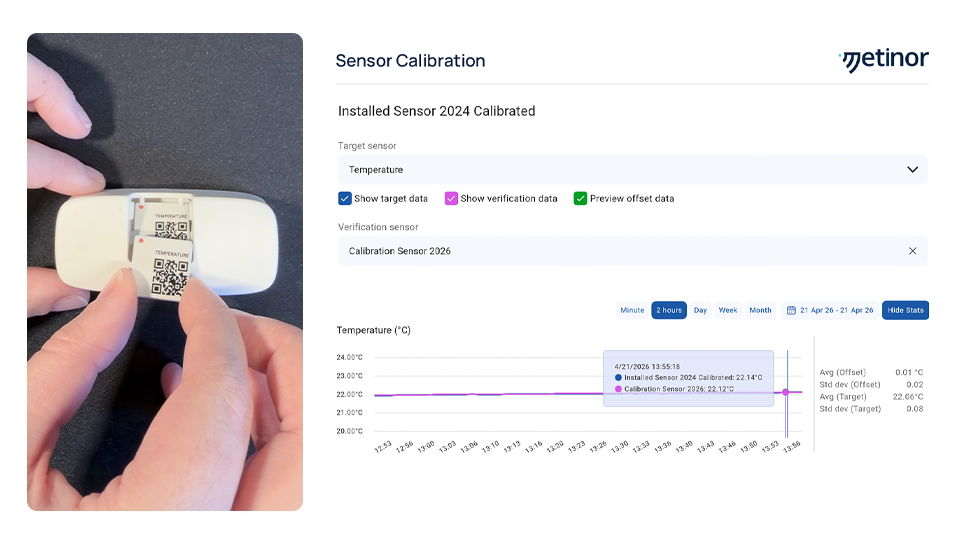
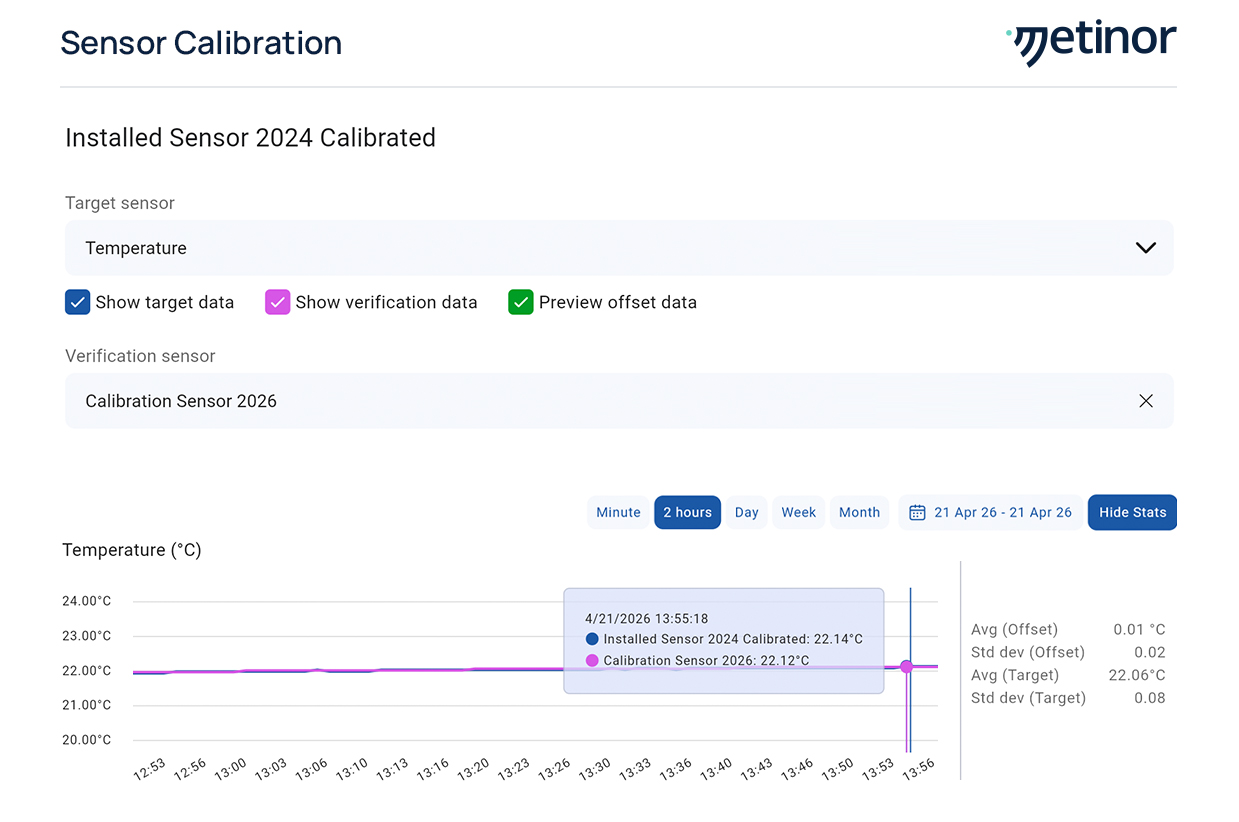
Rather than removing the installed sensor, a newly calibrated reference sensor can be placed alongside the existing sensor under identical environmental conditions. The system then compares measurements collected over a defined verification period.
This approach offers several advantages.
- Both sensors experience the same temperature conditions.
- Results are objective.
- The comparison is documented automatically.
- Verification records become available for future audits and investigations.
In the case of Metinor’s temperature verification process, a calibrated ISO 17025-certified reference sensor is placed in a dedicated verification slot above the installed sensor. Measurements are collected simultaneously, compared automatically by the software, and stored together with the associated documentation.
Building Stronger Audit Readiness
The most successful audits are rarely the result of perfect documentation. They are usually the result of confidence.
- Confidence that procedures are being followed.
- Confidence that records are complete.
- Confidence that data can be trusted.
When auditors ask about sensor accuracy, they are ultimately evaluating confidence in the monitoring program.
Organizations that can demonstrate:
- Traceable calibration
- Documented verification procedures
- Historical records
- Consistent review processes
- Clear acceptance criteria
tend to navigate these discussions much more comfortably. The conversation shifts from defending data to demonstrating control.
The Future of Environmental Monitoring Compliance
Regulated environments continue to place increasing emphasis on data integrity. Environmental monitoring records influence quality decisions, product release decisions, investigations, and regulatory assessments.
As a result, organizations are looking beyond minimum compliance requirements. They want systems that help them answer difficult questions before auditors ask them.
- When was the sensor calibrated?
- How was accuracy verified?
- What evidence supports the data?
- Can verification records be retrieved immediately?
- Can the process be demonstrated consistently across all monitored assets?
Facilities that can answer those questions quickly and confidently place themselves in a much stronger position during inspections.
Because in the end, auditors are rarely interested in the sensor itself. They are interested in whether you can trust the data. And proving that trust starts with proving the accuracy of the device collecting it.


Ready to upgrade your monitoring solution?
Get in touch and our team will help you make the switch today.